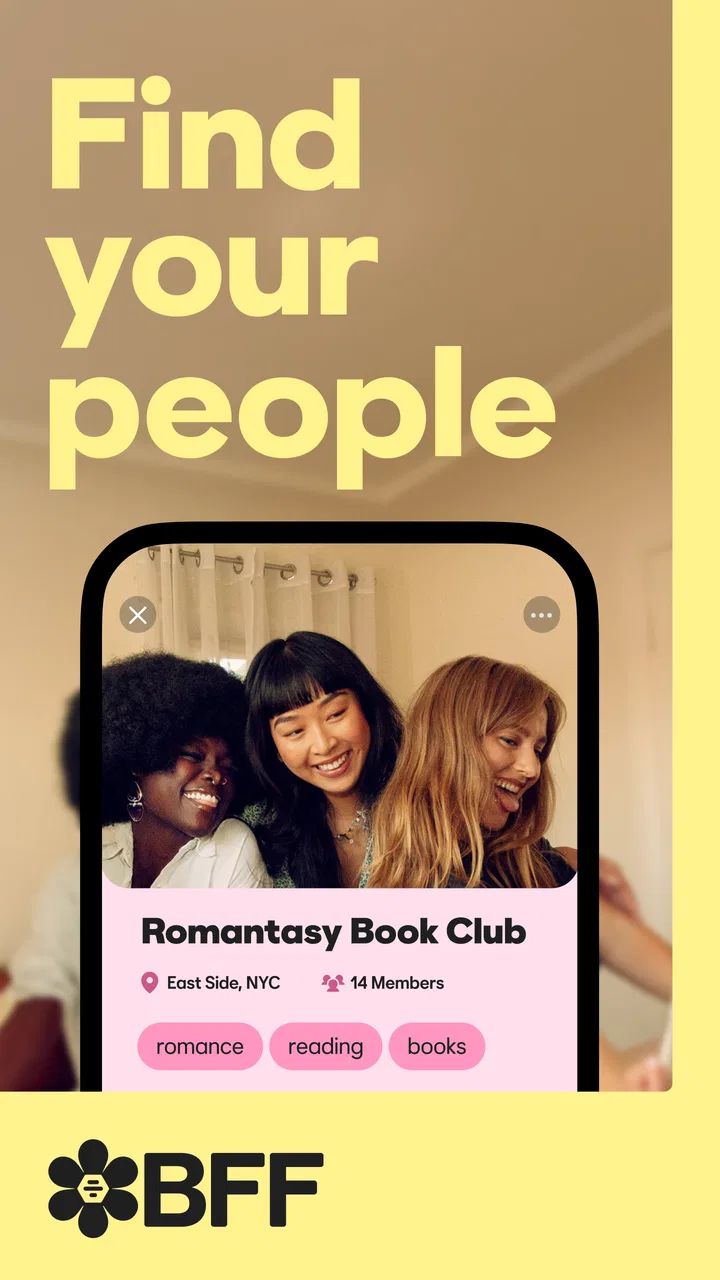
BFF: Make Friends & Meet Up
- 4.5
- Rating
- 500.00K
- Installs
- Free
- Price

 Analysis by App-foxy
I tried BFF: Make Friends as a lifestyle app for meeting people, starting conversations, and finding social activity beyond the usual circle of contacts. My first impression was that it is aimed at a very specific need: making friendship feel more intentional, rather than hoping a new connection happens by accident through another app. That focus gives it a clearer identity than a general social network, although it also means the experience depends heavily on how comfortable you are introducing yourself to people you do not already know.
The app is free, available for Everyone, and comes from Geneva Technologies, Inc. It has built a noticeable audience, with more than a hundred thousand installs and an average rating of 4.3 from roughly two and a half thousand ratings. Those numbers suggest that the concept has found a real audience, but they should not be read as a guarantee that every local community will feel equally active. A friendship app can be useful in one area and quiet in another, so I would treat the size of the overall audience as encouraging rather than conclusive.
How BFF fits into everyday friendship
I find BFF most useful when I treat it as a small, repeatable part of making connections rather than something to browse whenever I feel bored. A quick check of one group or conversation can help me decide whether there is a genuine next step, while keeping my attention on people who share an interest instead of collecting matches. That routine also makes it easier to notice when the local community is not giving me enough reason to return.
You May Also Like

 Blood Strike: 2.5 Anniversary
Blood Strike’s Loadouts Turn Every Drop Into a Tactical Gamble
A close look at Blood Strike’s custom loadouts: how fast access to signature weapons reshapes its battle royale rhythm, rewards preparation, and narrows the gap between fights.

 Pandora - Music & Podcasts
Pandora’s Music Is Easy to Start, but Harder to Recover
Pandora’s strength is its low-effort path from a seed to a station. Its weak spot is how much confidence it asks you to place in connection, setup, and quiet recovery.

 8 Ball Pool
 Is Built on Rivalries, Rematches, and Routine
A close look at the rivalries, rematches, shared routines, and unanswered safety questions that turn a quick pool match into a persistent mobile community.

 Samsung Music
’s Quiet Strength Is Playing What You Already Own
Its reach comes less from spectacle than from dependable access to a personal library. That simplicity is both the app’s strongest retention engine and its ceiling.

 AccuWeather: Weather Radar
AccuWeather Review: A Quick, Clear Forecast for Everyday Decisions
For everyday plans, the best forecast is the one you can understand quickly. AccuWeather makes rain timing, radar, and local conditions easy to act on, with a few trade-offs.

 Hill Climb Racing
Why Hill Climb Racing Still Turns Crashes Into One More Run
A tiny car, a bumpy hill and one more upgrade: Hill Climb Racing keeps resurfacing because its simple chaos makes every near-miss feel personal.
More From Our News Desk
View All News


A more direct alternative to ordinary social media
What I like about BFF is that it puts the purpose of the interaction in the open. On a typical social network, you may follow someone because of a shared interest, reply to a post, or gradually become familiar with them. That can work, but it is slow and often ambiguous. Here, the basic idea is much easier to understand: you are looking for new friends, chatting with people near you, and exploring groups or social events.
That makes the app especially relevant after a move, during a change in routine, or when existing friendships no longer match your schedule. Someone who works remotely, studies from home, has recently relocated, or simply wants to meet people outside a long-established circle may appreciate the directness. I also see value for people who prefer a smaller social step than walking into an unfamiliar event alone.
The trade-off is that direct friendship apps can feel more exposed than casual browsing. You are not merely sharing content and waiting for conversation to happen; you are presenting yourself as someone who wants to connect. I found that the quality of the experience depends on writing a profile that gives another person an easy opening. A short note about a hobby, a local place you enjoy, or the kind of social activity you want to try is more useful than a vague statement that you are “looking for friends.”
What the main areas are good for
The people-near-you element is the most practical starting point when you want to turn an online connection into something local. It can help narrow the enormous world of social networking into conversations that might realistically continue offline. Still, proximity should not be treated as a reason to trust someone quickly. Nearby does not automatically mean compatible, respectful, or safe.
Chat is better suited to testing that compatibility before making plans. I would use the first few exchanges to see whether the other person responds thoughtfully, respects boundaries, and shows genuine interest instead of rushing toward personal details or an immediate meeting. A good conversation does not need to become a friendship at once. The app is more useful when treated as a way to discover possibilities, not as a promise of instant companionship.
Groups can be valuable for people who find one-to-one introductions awkward. A shared topic gives the conversation somewhere to go, and participating in a group can reveal how someone behaves around others before you decide whether to continue privately. Events offer a similar advantage: they can provide a clearer social context than an isolated chat. I would still check the practical details inside the app and use my own judgement rather than assuming that every event will suit my comfort level.
A realistic way to use it during a busy week
Imagine moving to a new neighborhood while working irregular hours. Instead of trying to build a friendship through random social posts, you could open BFF after work, look through nearby people or groups, and focus on one shared interest. You might exchange a few messages during the week, then consider an event or public meet-up when the conversation feels natural. That workflow is more realistic than expecting a single swipe or message to solve loneliness immediately.
My practical advice is to keep the first session small. Choose one or two conversations, answer with enough detail to show personality, and avoid treating every reply as an obligation. If the app becomes another stream of notifications that you feel pressured to maintain, the original purpose is lost. Friendship takes time, and BFF works best as a doorway into social opportunities rather than a replacement for the gradual work of getting to know people.
Trust starts with the choices you can see
Because this app involves meeting unfamiliar people, I pay attention to visible user choices more than polished presentation. I want to know what I am choosing to share, who can contact me, and whether I can step away from a conversation without making a dramatic exit. The most reassuring approach is to review every profile field and interaction option before filling them in. Share only what helps someone understand your interests and general social goals.
I would also avoid putting precise location information, a daily schedule, workplace details, or other identifying clues into a public-facing profile. A nearby-friend feature is useful because it creates local relevance, but that does not mean an exact routine belongs in your introduction. Keep the first conversation general, and move toward more personal information only after consistent, respectful interaction.
The app’s public age rating is Everyone, which makes careful personal judgement especially important. An age label is not a substitute for evaluating individual conversations or deciding what is appropriate for you. Younger users and anyone who feels uncertain about meeting people online should involve a trusted adult or friend in their plans and avoid arranging private first meetings.
Account control matters more than a large audience
A service can have a strong community and still be a poor fit if you feel unable to control your participation. Before investing time, I would look through the account and profile settings, note what information is optional, and check the available ways to manage unwanted contact. I would also make sure I understand how to leave a group, stop a conversation, or remove my account if I decide the experience is not for me.
Those checks are not signs of distrust; they are basic digital housekeeping. They also make the app easier to use because you can participate with a clearer idea of your boundaries. If a profile prompt feels too personal, skip it. If a conversation becomes uncomfortable, you do not owe the other person a detailed explanation. The best social tools give users room to change their mind.
I would be cautious about treating a friendly profile as proof of identity. Photos, shared interests, and a pleasant writing style can create an impression, but they are still only impressions. Keep early communication inside the app when possible, do not send money or sensitive documents, and be suspicious of anyone who pressures you to move quickly, hide the interaction, or disregard your limits. These habits are useful regardless of which friendship service you choose.
Handling personal data without guessing
Any app that supports profiles, local discovery, messaging, groups, and events naturally creates moments where personal information may be involved. I would read the current privacy and permission screens during setup rather than accepting every prompt automatically. If the app asks for access that is not necessary for the way I want to use it, I would pause and consider whether the convenience is worth it.
This is also a good reason to separate essential information from optional self-expression. You can describe your interests without publishing a full biography. You can decide whether a conversation deserves more context before sharing details about your home, work, family, or routine. A useful rule is to imagine that a message or profile detail could be seen by someone outside the intended conversation; if that possibility would bother you, leave the detail out.
I would revisit these choices after an update or a change in how I use the app. The current version is 3.1.17.5076, and keeping an app updated can bring improvements as well as changes to screens or controls. When an app changes, I prefer to glance through settings again instead of assuming that every choice remains in the same place.
Where the experience may feel limited
The biggest limitation is not necessarily a missing button; it is the uncertainty of community quality. A large install count does not tell me whether there are many suitable people near my home, whether conversations are active at the time I open the app, or whether the groups match my interests. If local participation is thin, the app may feel repetitive even though the service itself is well designed.
There is also a social cost to browsing profiles. Some users may approach the experience like dating, while others may want only activity partners or casual local friendships. If expectations are not aligned, conversations can become uncomfortable. I would state my intentions early and move on quickly when the other person seems to want something different.
People who prefer a highly moderated, structured club environment may be happier with an established community organization, a class, or a hobby-specific service. Those alternatives can provide more context before the first interaction. On the other hand, people who want broad local discovery and the flexibility to explore different kinds of social connections may find BFF more convenient than joining several separate groups.
Who should try it, and who should skip it
I would recommend giving BFF a chance if you want to meet people locally but do not know where to begin, especially if you are willing to start with messages and shared interests rather than expecting immediate plans. It is also a reasonable option for someone who wants both individual conversations and group-based ways to participate. The combination lets you choose a gentler entry point when direct introductions feel too intense.
I would skip it if you dislike initiating conversations, want guaranteed activity in your neighborhood, or are looking for a service with a tightly defined professional, dating, or hobby purpose. The app’s broad friendship focus is its strength, but that breadth can also make the experience less predictable. If you already have a reliable local community through classes, volunteering, or clubs, those settings may offer richer face-to-face context.
People concerned about privacy should not automatically reject the app, but they should use a restrained profile and inspect the visible controls before becoming active. I would not install it casually and immediately publish every social detail. Start with the minimum information needed to see whether the community feels worthwhile, then expand only if the interactions remain comfortable and useful.
My overall take after weighing usefulness and caution
BFF is a focused lifestyle app with a sensible purpose: helping people look for friendship, conversation, groups, and local social opportunities in one place. I appreciate that it addresses a real problem that ordinary social feeds often leave unresolved. Its strongest use is as a low-pressure starting point for someone who wants to widen their circle but needs a practical way to find relevant people and activities.
At the same time, I would not judge it only by its rating, audience size, or clean concept. The important questions are personal: Are there people nearby who share your interests? Do the conversations feel respectful? Are the profile and account choices comfortable for you? Can you use the app without revealing more than you intended? Those answers will determine whether it becomes a helpful bridge or just another social inbox.
For me, the right approach is deliberate and modest. I would complete a limited profile, explore groups before arranging one-to-one meetings, keep early conversations general, and use public settings for any first meeting. I would also review permissions, privacy choices, and account controls whenever the app changes. The best reason to use BFF is not instant friendship, but a clearer path toward finding compatible people while keeping control of the pace.
As a free app developed by Geneva Technologies, Inc, it is easy to test without committing money, and its Everyone rating makes it broadly accessible. Just remember that accessibility is not the same as suitability for every conversation or situation. If you approach it with realistic expectations, careful sharing habits, and a willingness to leave unproductive chats behind, it can be a useful addition to your search for local connection.
My cautious verdict is positive: I would recommend trying it to people who are actively looking for new friends and are comfortable taking responsibility for their own boundaries. I would not recommend relying on it as the only way to build a social life. Use it to discover possibilities, then judge each person, group, and event on its own merits. That balance lets the app do what it does best without giving away more trust than the situation has earned.
FAQs for BFF: Make Friends & Meet Up
01What is BFF: Make Friends by Bumble?
BFF: Make Friends by Bumble is a social networking app designed to help users forge new friendships. Unlike traditional dating apps, BFF focuses on connecting people with similar interests for platonic relationships. It's perfect for those looking to expand their social circle or meet like-minded individuals in their area.
02How does BFF: Make Friends work?
BFF: Make Friends operates similarly to dating apps but emphasizes friendship. Users create a profile highlighting their interests and preferences. The app then suggests potential friends based on compatibility and location. Swiping right indicates an interest in connecting, while swiping left passes on the suggestion. Mutual interest results in a match, allowing users to chat.
03Is BFF: Make Friends safe to use?
BFF: Make Friends by Bumble places a strong emphasis on safety. The app includes robust privacy settings and verification features to ensure users feel secure while connecting with others. Additionally, Bumble's community guidelines and reporting tools help maintain a respectful and harassment-free environment for all users.
04Are there any costs associated with using BFF: Make Friends?
BFF: Make Friends is free to download and use, with optional in-app purchases available. These purchases can enhance the user experience by providing features like unlimited swipes or advanced filters. However, the app's core functionality, which includes finding and chatting with new friends, remains accessible without payment.
05Can I use BFF: Make Friends without connecting to Facebook?
Yes, BFF: Make Friends offers different sign-up options, including using a phone number or email address. While initially connected to Facebook for verification purposes, the app has evolved to accommodate users who prefer to keep their social media accounts separate, ensuring a wider range of privacy options.
Pros
- User-friendly interface for easy navigation.
- Diverse community for making global connections.
- Strong privacy settings ensure user safety.
- Innovative friend-matching algorithm.
- Free version offers substantial features.
Cons
- Limited filters in the free version.
- Occasional glitches in chat features.
- Some profiles lack detailed information.
- Ads can be intrusive in free mode.
- Requires a stable internet connection.

BFF: Make Friends & Meet Up
Gallery